Email Printer Friendly
Study links frequent dental x-rays with brain tumor
By Kathy Kincade, Editor in Chief

April 10, 2012 -- People who received frequent dental x-rays have an increased risk of developing meningioma, the most commonly diagnosed primary brain tumor in the U.S., according to a study published today in Cancer (April 10, 2012).

The findings should serve as a reminder to patients and practitioners alike to carefully assess the need for diagnostic imaging procedures and to limit the frequency of x-rays based on the recommendations of professional organizations, such as the ADA.

Ionizing radiation is the primary environmental risk factor for developing meningioma, a largely benign brain tumor, and dental x-rays are the most common artificial source of exposure to ionizing radiation for individuals in the U.S., the study authors noted.

“All epidemiology studies ... suggest a correlation, not a cause and effect.”
— Elizabeth Claus, MD, PhD, Yale University School of Medicine

To examine the link between dental x-rays and the risk of developing meningioma, Elizabeth Claus, MD, PhD, of the Yale University School of Medicine and Brigham and Women's Hospital, together with colleagues from multiple other academic medical centers, studied information from 1,433 patients who were diagnosed with the disease between the ages of ages 20 and 79 and were residents of the states of Connecticut, Massachusetts, North Carolina, the San Francisco Bay Area, and eight counties in Houston, TX, between May 1, 2006 and April 28, 2011.

They also studied information from a control group of 1,350 individuals who had similar characteristics but who had not been diagnosed with a meningioma.

To avoid attributing the effect of therapeutic ionizing radiation to dental x-rays, individuals who had received therapeutic radiation to the head, neck, chest, or face were removed from all analyses that assessed the risk associated with dental x-rays, the study authors noted.

"All epidemiology studies are imperfect and only suggest a correlation, not a cause and effect," Dr. Claus told DrBicuspid.com. "But we did collect information on other sources of common ionizing radiation, particularly therapeutic. We tried to control for other things that we knew would be an issue."

'Apparent association'

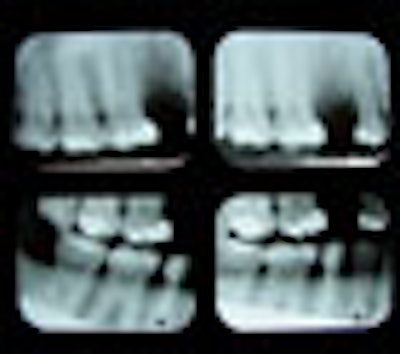
Over a lifetime, patients with meningioma were more than twice as likely as controls to report having ever had a bitewing exam, the researchers found. Individuals who reported receiving bitewing exams on a yearly or more frequent basis were 1.4 to 1.9 times as likely to develop meningioma as controls. (Risks differed depending on the age at which the exams were done).

An increased risk of meningioma was also linked to panorex exams taken at a young age or on a yearly or more frequent basis. Individuals who reported receiving these exams when they were younger than 10 years old had an increased risk (4.9 times) of developing meningioma. Those who reported receiving them on a yearly or more frequent basis were 2.7 to 3 times (depending on age) as likely to develop meningioma as controls.

Previous studies have reported similar findings, the study authors noted (Neuroepidemiology, 1989, Vol. 8:6, pp. 283-295; Oral Oncology, July 1998, Vol. 34:4, pp. 265-269; Cancer, March 2004, Vol. 100:5, pp. 1026-1034). However, no recent large-scale studies of meningioma risk relative to common ionizing radiation exposure exist, when doses for dental and other procedures have decreased but new radiography procedures have been introduced, they added.

"To our knowledge, this is the largest case-control study to date examining the correlation between dental x-rays and the risk of meningioma," the study authors wrote. "And because it is the most recent study, it provides an improved examination of the effects of reduced dosing exposure levels over time."

Dental patients today are exposed to lower doses of radiation than in the past, they noted. Allan Farman, BDS, MBA, PhD, DSc, a professor of radiology and imaging science at the University of Louisville in Kentucky and immediate past-president of the American Association for Oral and Maxillofacial Radiology, agreed.

"This is not the first time that the subjective memories of patients with meningioma have resulted in an apparent association between dental x-ray use and the likelihood of meningioma," Dr. Farman told DrBicuspid.com. "In each case, the conclusions clearly state that associations are related to radiation received many years ago when dental x-ray exposures were substantially higher than is presently the case.

"Perhaps inclusion of information on radiation exposure of non-dental origin, such as medical CT to the head -- which is orders of magnitude greater in dose than that from dental radiographs -- would have been beneficial to better view the findings in a wider context."

Time to 'Image Wisely'

Other study limitations include the possibility of under- or over-reporting of dental x-rays by the participants, Dr. Claus and her co-authors noted.

"This is a difficult problem in epidemiology because, unlike medical care, which ... may be confirmed by a review of centralized medical records, dental care generally is obtained ... from numerous dentists, all of which are outside of a health maintenance organization or hospital-based setting, providing little opportunity for researchers to validate dental reports in a timely or cost-efficient manner," they wrote.

Arthur Goren, past director of radiology at SUNY Stony Brook School of Dental Medicine and currently clinical associate professor in the department of cariology and comprehensive care at New York University College of Dentistry, also questioned the study's methodology.

"The only way bitewing x-rays can cause brain tumors is through scatter radiation," he told DrBicuspid.com. "If the scatter reaches the brain, why are tumors not found in the thyroid, eye, parotid, and oral epithelium? We have dosimetry studies of cone-beam CT exposures to the head and neck of adult male and female and juvenile phantoms that show that the other organs received more scatter radiation than the brain and cranium.

"I realize CBCT dosimetry is not an adequate comparison with bitewing dosimetry, but to base findings on anecdotal recollections and not on statistical data is a reach," he added. "I wonder what the conclusions would be if you substituted cell phone use instead of bitewing x-rays."

Nevertheless, Dr. Farman said, "this study has value in that it does remind clinicians (including dental practitioners) that x-radiation has been defined by the U.S. Food and Drug Administration as a carcinogen and that radiographs should only be made following professional prescription and never as a mere routine."

The study presents an ideal opportunity in public health to increase awareness regarding the optimal use of dental x-rays, which, unlike many risk factors, is modifiable, Dr. Claus noted. The ADA's guidelines for healthy persons suggest that children receive 1 x-ray every one to two years; teens receive one x-ray every one-and-a-half to three years, and adults receive one x-ray every two to three years (Journal of the American Dental Association, September 2006, Vol. 137:9, pp. 1304-1312).

The use of ionizing radiation should always be based upon professional judgment after taking a history and clinical inspection, Dr. Farman added.

"We should always 'Image Wisely' irrespective of the region being examined, and this includes radiographs needed for dental diagnosis," he said. "With careful selection made by a professional, there is no doubt that dental-imaging procedures can reduce pain and suffering and also that early intervention can reduce the costs of treatment intervention involved."

Radiation can damage oral mucosa cells, March 27, 2012

Studies support use of leaded glasses, thyroid collars, January 24, 2012

European group issues dental CBCT guidelines, September 2, 2011

Irish regulators update dental x-ray position statements, July 8, 2011

Do dental x-rays increase thyroid cancer risk?, March 8, 2011


Copyright © 2012 DrBicuspid.com

Last Updated kk 4/11/2012 6:33:05 AM

4 comments so far ...
4/11/2012 11:01:27 AM
PremierDentalandOralHealthGroup
[link=http://www.facebook.com/notes/premier-dental-oral-health-group-pc/dental-x-rays-and-meningioma-please-read-more-than-just-the-headlines/10150742543514686]http://www.facebook.com/notes/premier-dental-oral-health-group-pc/dental-x-rays-and-meningioma-please-read-more-than-just-the-headlines/10150742543514686[/link]
 
Yesterday several television programs and media websites discussed a recent study that associates yearly or more frequent dental x-rays to an increased risk of developing a non-cancerous meningioma brain tumor and we know you probably have questions about this issue. We would like to offer the following points to help answer those questions and ease any concern you may have.
  • The American Dental Association as well as the television programs airing yesterday noted that the results of this study rely on the individuals' memories of having dental X-rays taken years earlier (“The main outcome measure for the study was the association between a diagnosis of intracranial meningioma and self-reported bitewing, full-mouth, and panorex dental x-rays.”), not a review of the patients' dental or medical records. Results of studies that use this type of design method can be unreliable.
  • “Participants (mean age was 57.5 years) were asked to report the number of times they had received bitewing, full-mouth, or panoramic (panorex) films during 4 periods: when aged
  • In the largest (n=200) previous case-control study to date of dental x-rays and meningioma… both cases and controls tended to overestimate the number of dental X-ray visits.”
  • The study also acknowledges that some of the subjects received dental X-rays decades ago when radiation exposure was substantially greater because of the use of old X-ray technology and slower speed film. “Our findings suggest that dental X-rays… may be associated with an increased risk of intracranial meningioma, at least for the dosing received by our study participants.”
  • Because of the advent of digital X-rays and improved speed of X-ray film, the amount of radiation that dental patients are exposed to today is significantly lower than it used to be. In 2006, Premier Dental & Oral Health Group spent over $75,000 upgrading to digital X-ray methods; this lowered the amount of radiation exposure to our patients by over 75 percent.
  • The following is quoted directly from the conclusion portion of the published journal article: “Exposure to some dental x-rays performed in the past, when radiation exposure was greater than in the current era, appears to be associated with an increased risk of intracranial meningioma.”
  • The article states “regardless of the age, more frequent receipt of bitewing films was associated with increased risk.” Today, bitewing X-ray machines employ collimation, which became available in the late 1980s, directs the radiation in a straight line, and limits its divergence and dispersion with distance. Collimation has always been used in our office.
  • Arthur Goren, past director of radiology at SUNY Stony Brook School of Dental Medicine and currently clinical associate professor in the department of cariology and comprehensive care at New York University College of Dentistry, also questioned the study's methodology. "The only way bitewing x-rays can cause brain tumors is through scatter radiation," he said. "If the scatter reaches the brain, why are tumors not found in the thyroid, eye, parotid, and oral epithelium? We have dosimetry studies of cone-beam CT exposures to the head and neck of adult male and female and juvenile phantoms that show that the other organs received more scatter radiation than the brain and cranium. I realize CBCT dosimetry is not an adequate comparison with bitewing dosimetry, but to base findings on anecdotal recollections and not on statistical data is a reach," he added. "I wonder what the conclusions would be if you substituted cell phone use instead of bitewing x-rays.”
  • “Data from Israel provide evidence for genetic predisposition to radiation-associated meningioma, highlighting the role of inherited genetic factors… in the development of meningioma.”
  • “The primary environmental risk factor consistently identified for meningioma is exposure to ionizing radiation (IR). The use of other medical [non-dental] imaging procedures (and, hence, exposure to IR) is on the rise, with the National Council on Radiation Protection and Measurements reporting that the per capita dose of radiation from medical imaging has increased by a factor of approximately 6 since the early 1980s. For the most part, these procedures are associated with even higher levels of exposure to IR than are bitewing or full-mouth dental X-rays.”
  • One author of the article, Elizabeth B. Claus, MD, PhD, is quoted as saying, “All epidemiology studies…only suggest a correlation, not a cause and effect.” The article also states “[radiation exposure] doses for dental and other procedures have decreased [recently] but during which time new radiographic procedures have been introduced, including CT,” and that “no studies have reported on the association between use of computed tomography (CT) and meningioma risk.”
  • The authors also noted that “perhaps inclusion of information on radiation exposure of non-dental origin, such as medical CT to the head – which is orders of magnitude greater in dose than that from dental radiographs – would have been beneficial to better view the findings in a wider context.”
  • One hundred fourteen cases in the study reported that they received previous radiation therapy to the head, neck, face or chest.
  • Dental X-rays are valuable because many oral diseases cannot be detected on the basis of a visual and physical examination alone. Such radiographs provide important diagnostic information about a patient's oral health such as early-stage cavities, gum diseases, infections, and even some types of tumors.
  • According to the ADA, how often dental X-rays should be taken depends on the patient's oral health condition, age, risk for disease, and any signs and symptoms of oral disease that the patient may be experiencing. The ADA has published recommendations to help dentists ensure that radiation exposure is as low as reasonably achievable.
  • Allan Farman, BDS, MBA, PhD, DSc, a professor of radiology and imaging science at the University of Louisville in Kentucky and immediate past-president of the American Association for Oral and Maxillofacial Radiology, said, “We should always 'Image Wisely' irrespective of the region being examined, and this includes radiographs needed for dental diagnosis. With careful selection made by a professional, there is no doubt that dental-imaging procedures can reduce pain and suffering and also that early intervention can reduce the costs of treatment intervention involved."
  • The ADA encourages patients to carefully read the full article ([link=http://onlinelibrary.wiley.com/doi/10.1002/cncr.26625/pdf]http://onlinelibrary.wile...10.1002/cncr.26625/pdf[/link][link=http://onlinelibrary.wiley.com/doi/10.1002/cncr.26625/pdf)])[/link] and talk to their dentists if they have questions about their dental treatment. We would be happy to speak with you if you have further concerns. Please send us a message or email us at [email=patientcare@thepremierdentalgroup.com]patientcare@thepremierdentalgroup.com[/email] and we will get back to you as soon as possible.
4/11/2012 2:02:00 PM
glenp
The study is so bogus  in that it used "anecdotal recall" of the patients, "remembering" how many films had been taken over a lifetime. Yup  same  as I remember how many beers I ever drank.
The results were also suspect in that FULL MOUTH SERIES showed a lower propensity for tumors than bitewings taken. Yup another valid finding.
Now we all will need to deal with our know-it-all patients that read this tripe and start telling us how to practice.
I'd rather deal with nyscof  and his anti fluoridationist rants.
4/11/2012 6:57:54 PM
dentalegal
Please add this: When it happens to a patient, it's an anecdote.  When it happens to you, it is science.  I am a 76-year old semi-retired dentist who curiously never had a carious lesion in my mouth, thus I rarely had intra-oral radiographs.  Nevertheless I now have an intra-thecal meningioma that my neurosurgeon says I should outlive.  There are many sources of problems in our lives.
Joel M Berger DDS, JD   Miami, FL
4/12/2012 12:36:56 PM
RELDDS51
I have a problem with the manner in which the study was reported on the TV news. They emphasized the link. what they failed to emphasize is that the problem is apparently related to older dental x-ray exposure from many years ago and not our current machines, fast speed film and digital sensors. They also did not emphasize that it was a benign tumor.
Also all the while they were discussing dental individual radiographs, they were showing patients undergoing CTScans. They said zero about the amount of radiation from those and did not mention chest x-rays, etc. which typically has tremendous scattered radiation compared to a dental and I have almost never been given a lead apron. That is something we use on every patient regardless of age or sex.
They also said nothing about lateral face or panoramic x-rays - you would think those would be much more scattered radiation to be concerned about.
Email Printer Friendly


|| 15 Minutes to Excellence || ADA News || Advertising || Ask Marty || Case Archives || Case Study || Communities || Conferences || Contact Us || Education || Equipment For Sale || Facebook || Forums || Future of Dentistry || Home || Hygienist Resources || Jobs || Links || Mobile || News in Brief || Online CE || Opinion || Privacy Policy || Twitter || Vendor Connect || Video || XML/RSS ||

Copyright © 2013 DrBicuspid.com. All Rights Reserved.