Email Printer Friendly
The pros and cons of panoramic bitewings
By Kathy Kincade, Editor in Chief

August 2, 2012 -- Do panoramic bitewings offer enough advantages over intraoral bitewings to warrant using this extraoral method rather than the traditional approach? Some manufacturers and clinicians contend they do, but others say more peer-reviewed research is needed.

"Traditionally, dentists have believed that the resolution of panoramic x-rays and the ability to open the contacts were not as good as with traditional bitewings," wrote Robert Langlais, DDS, MS, a professor at the University of Texas Health Science Center at San Antonio, earlier this year in Dental Economics. However, he noted, "recent research ... has determined how to open the posterior contacts to get a panoramic bitewing" (Dentomaxillofacial Radiology, January 2010, Vol. 39:1, pp. 47-53).

He goes on to list six reasons why dental practitioners should consider using a panoramic x-ray system for bitewings:

  1. Better patient acceptance
  2. Easier for the dentist and staff
  3. Faster
  4. More diagnostic
  5. Less radiation exposure
  6. Better infection control

"There are literally no downsides to this," said Jim Hooper, the district sales manager for Planmeca, which markets its Promax system for this application and has sold more than 300 systems in the past two years specially for pano bitewings. "There is less radiation to the patient; if you use round collimation and D-speed film, four bitewings have five times the dose of one pano. Also, it takes less time; it can take five minutes or more to take an intraoral bitewing series."

In addition, he noted, by using the Promax to take bitewings, the practitioner is able to see the apices and do more dentistry, "because you are basically taking a full-mouth series with the pan."

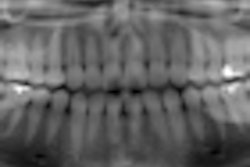
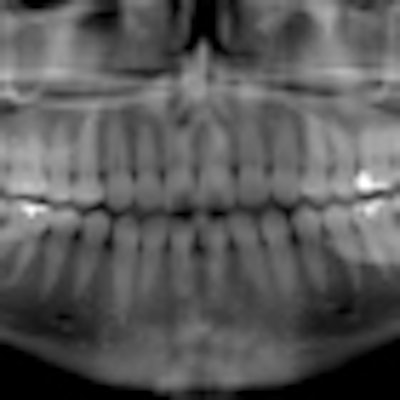
Click here to enlarge this image.
These panoramic bitewings took 15 to 20 seconds to create, compared with 20 minutes for a full-mouth intraoral survey (Dentomaxillofacial Radiology, January 2010, Vol. 39:1, pp. 47-53).

From the patient's perspective, "there isn't one patient alive who says they enjoy the sensor experience," Hooper said. "So if you give them the choice of standing there and biting on a bite stick while the pan goes around their head, versus chomping on a sensor four times, they will pick the pano every time."

The only potential downside is related to positioning, he acknowledged. "If you do the positioning poorly, you won't get open contacts," he said.

The Promax opens contacts at least as consistently, "if not more so," than any intraoral modality except maybe film, Hooper added. "Sensors are not pliable, and you have to place them more toward the midlines," he said. "You can't place the sensor as easily as the film, but with the Promax you don't even have to think about things like gag reflexes."

More research needed?

But not everyone is convinced that panoramic bitewings are a superior alternative to traditional intraoral bitewings. In a study presented at the 2011 annual meeting of the American Academy of Oral and Maxillofacial Radiology in December, researchers from Ankara University and Gulhane Military Medical Academy compared the two types of images for diagnosing proximal caries and found that intraorals came out ahead.

For this study, they placed 80 extracted human teeth with and without proximal caries in the alveolar sockets of a dry human skull. They obtained intraoral bitewings using Kodak Insight film and extraoral bitewings and panoramic images using the Planmeca Promax system.

The film and printed digital images were evaluated separately by three observers using a five-point scale; evaluations of each image set were repeated one week after the initial viewings. Az values for each image type, observer, and reading were compared using z-tests.

The researchers assessed a total of 160 proximal surfaces of 80 teeth and found that the Az values for both readings of all three observers were highest for the intraoral bitewings. In addition, the Az values for the extraoral bitewing images were higher than those of the panoramic images. No differences (p > 0.05) were found between the Az values of the extraoral bitewing and panoramic images for all observers.

"Intraoral bitewing radiography was superior to extraoral bitewing radiography and panoramic radiography in diagnosing proximal caries of premolar and molar teeth ex vivo," the study authors concluded.

Donald Tyndall, DDS, MSPH, PhD, the director of oral and maxillofacial radiology at the University of North Carolina at Chapel Hill School of Dentistry, also questions some manufacturers' claims.

"Some companies promote pano bitewings for difficult or special cases, such as gagging situations and patients with small mouths, and I'm OK with that," he said. "I am not opposed to the concept of pano bitewings; I just want proof that it works, and we haven't seen that. It is a good concept and worthy of continuing the research. If people have the data [to support pano bitewings], they should publish it in a peer-reviewed journal."

Will tomosynthesis enhance panoramic bitewings?, March 30, 2010


Copyright © 2012 DrBicuspid.com

Last Updated hh 8/2/2012 8:36:28 AM

6 comments so far ...
8/6/2012 11:38:25 AM
KCalla
Isn't the result of the study that Intraoral FILM bitewing radiography was superior to extraoral bitewing radiography and panoramic radiography in diagnosing proximal caries of premolar and molar teeth ex vivo.
8/6/2012 12:14:35 PM
fredo
I had never heard of "panoramic bitewings" before.  Sounds almost like a contradiction-in-terms actually, yet something we'd all like to think is possible despite knowing better by way of clinical experience, education, and logic.  Still, I believe that there are good reasons for the fact that we are all now being "educated" about so-called panoramic bitewings:
1) Equipment Marketing.
2) Equipment Marketing.
3) Equipment Marketing.
12/3/2012 1:58:21 PM
vomer6
another "new" standard by sales people
12/4/2012 4:39:09 PM
Administrator
From Dr. Allan Farman:
Cropping a panoramic radiograph does not a bite-wing make and has several issues. First, if only bite-wings are needed then the extra volume of tissue exposed is unacceptable from a radiation hygiene viewpoint. Second, most panoramic radiographs result in unacceptable proximal surface overlap in the maxillary canine and first premolar region. Third, extra-oral imaging whether film or digital results in spatial resolution that is at best a third of that achievable with intra-oral film or digital sensors. Fourth, a bite-wing is so called because it is achieved using a holder or tab with a "wing" situated between the maxillary and mandibular teeth... something that is not done with a cropped  panoramic image.

Last week I attended the Radiological Society of North America meeting in Chicago. The mantra of that meeting was (1) Patients First; (2) Image Wisely based upon evidence-based appropriateness criteria; and (3) Image Gently by child-sizing X-ray exposure to children. At the commercial exhibition the vendors were competing on supporting these tenets and curtailing dose. Indeed, many medical manufacturers have achieved up to an order of magnitude dose reduction in the recent past. It is not acceptable to RSNA to use such descriptors as "low dose" but rather to be more specific to eliminate all unnecessary dose. It is not acceptable to use electronic "collimation" than cuts an image from a larger than needed exposure... collimation should be physical. The concept of "panoramic bite-wings" is an anathema if one wishes to follow these tenets, to say nothing of being a poor use of language as no "wing" is used for panoramic imaging.

It is time for the dental profession to follow our medical colleagues in demanding appropriateness be applied to image selection based upon task- and patient-specific diagnostic needs. It is time for manufacturers to concentrate on better diagnosis at reduced radiation dose rather than maximized dentist (and manufacturer) income with the patient far from First in the decision process.

Part of the problem was indicated to me in a recent 'phone call from a TV journalist. She had just tried to make a dental appointment for her daughter to get a check up. The front desk person who answered the 'phone wanted first to have the child attend a preliminary appointment for bite-wing radiographs. When the journalist asked if a new set of bite-wings were needed, the answer given was that the insurance company would pay for it and you don't want to waste your benefits. Availability of payment from a dental insurance company is not an appropriate deciding factor for diagnostic imaging... and there should not be prescription by the front desk for a procedure that should follow history taking and clinical inspection by the dentist. If we want to be a profession, then we need to act professionally.

It is now two years since Walt Bogdanich published in the New York Times just criticism of the excessive unnecessary exposure of children and teens by dentists, and particularly by orthodontists enchanted by pretty pictures from cone-beam CT. It appears that very little has been done by our profession in the time that has passed, except for many to bury their heads still deeper in the sand than any ostrich has ever achieved. Taking a panoramic image when a bite-wing or two are needed is not an advance for the profession.

Allan G. Farman,
Oral and Maxillofacial Radiologist
12/22/2012 3:57:33 PM
smdubowsky
In all due respect, I believe that having a protocol that utilizes extra oral bitewings does in act follow the ALARA principle. The Planmeca Promax 3s that I employ does not use a cropped pan for its bitewing but uses both a discreet program and a camshaft arm to take images that are very different from a conventional panoramic image. These images are produced with minimal exposure to the patient and are very diagnostic. When necessary we do follow up with an occasional intra-oral bitewing only when necessary as a follow up to the extra-oral image.
 
The frequency of these images is completely dependent on the clinical situation and not the insurance reimbursement. I will say that another advantage of the extra-oral bitewing is that the diagnostic image includes the apices of all non impacted teeth from the canine back through the molars.
Email Printer Friendly


|| 15 Minutes to Excellence || ADA News || Advertising || Ask Marty || Case Archives || Case Study || Communities || Conferences || Contact Us || Education || Equipment For Sale || Facebook || Forums || Future of Dentistry || Home || Hygienist Resources || Jobs || Links || Mobile || News in Brief || Online CE || Opinion || Privacy Policy || Twitter || Vendor Connect || Video || XML/RSS ||

Copyright © 2013 DrBicuspid.com. All Rights Reserved.