Tooth extractions are commonly associated with a fair amount of trauma. But they can become a matter of applying light pressure and waiting for a telltale "pop," signaling the disengagement of the periodontal ligament, according to the makers of Physics Forceps (GoldenMisch).
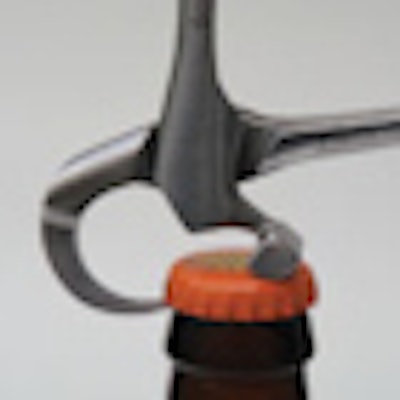
Unlike conventional oral surgery forceps, Physics Forceps are based on the physics of rotational force, torque, and a lever, much like the basic concept of a (non-twist-off) bottle cap removal, according to Carl Misch, DDS, a consultant for GoldenMisch, in a session at the recent Western Regional Dental Conference in Phoenix.
 Unlike conventional oral surgery forceps, Physics Forceps are based on the physics of rotational force, torque, and a lever. Image courtesy of GoldenMisch.
"Basically, what we've been doing [with conventional forceps] has been like trying to take a bottle cap and just pull it off, whereas any layperson would take a bottle cap opener, which is a lever, hook it onto the bottle cap, and lift one side to pull it off," Dr. Misch explained in a video during the session.
The Physics Forceps operate in a similar fashion: With the instrument opened wide, the beak is firmly placed on the lingual aspect of the root, and a flat bumper is placed at the mucogingival junction. Then, with only minimal wrist movement, the phenomenon of "creep" -- in which a material changes shape under a constant load -- should allow the tooth to become disengaged within a short time.
"You place the beak and the bumper and apply just a little bit of torque, you hold it, and you just stand there," explained Maureen Pisano, a long-time dental assistant who now markets Physics Forceps and presented the video and device at the meeting.
"You don't move and you don't squeeze, you just hold it still, and by the time you count to about 20, it just goes 'pop' and then you use an instrument of choice to remove it," she said.
Pisano noted that one of the key adjustments dental professionals need to make in using Physics Forceps is to avoid the instinct to squeeze too hard or engage the arm or shoulder in extracting the tooth, as may be necessary when using conventional extraction methods.
Biomechanical reaction
Biomechanical pressure, as opposed to brute force, is said to trigger a biochemical reaction in the periodontal ligament that results in a quicker release of the Sharpey's fibers to extract the tooth.
Specifically, the pressure instigates the release of the enzyme hyaluronidase, which catalyzes the hydrolysis of hyaluronan, known as the "cement substance" (extracellular matrix) of all human tissue, wrote Thomas Abrahamsen, DDS, in GoldenMisch promotional materials.
"Once this chemical breakdown of the periodontal ligament by hyaluronidase is sufficient, the tooth is released from its attachment to the alveolus and can be removed," he wrote.
By triggering the release of a greater amount of hyaluronidase in a shorter period of time, Physics Forceps are less traumatic to the alveolar bone than conventional forceps, he added.
The process preserves the buccal bone and cortical plate, and "virtually eliminates root top fractures," according to GoldenMisch.
In extracting lower molars, GoldenMisch recommends cutting the tooth in the middle with a surgical bur, then using the forceps to extract each section. The forceps can also be used even if the tooth is severely decayed or rotted, according to Richard Golden, DDS, who invented Physics Forceps.
"If the tooth is completely rotted, we use a flame-shaped diamond bur and take it down to create a purchase point," he said in another video presented at the meeting. "We're removing to the surface only, not the bone or the gum. This allows us to push the beak down a little farther and lock it on the tooth and then, again, it's the same principle -- simply wait."
In fact, as the periodontal ligament succumbs to the element of creep, patience is key, Dr. Golden added. "Don't rush the instrument. Let it do its work," he said. "Energy builds up and it separates the root from the bone, and the tooth, based on wrist movement, will start moving."
One fan of the Physics Forceps is Paul Feuerstein, DMD, a practicing dentist and well-known educator who writes and lectures about dental technologies. He admits that he has shied away from doing extractions for most of his 30-year career, but that in the past year that has changed since he began using the Physics Forceps.
"My introduction to the Physics Forceps was a scientific curiosity, and despite the claims of simplicity, I was skeptical," he told DrBicuspid.com. "But all I can say is that, since learning how to use this device -- which I think of as an 'elevator' rather than forceps -- I performed more extractions in the last quarter of last year than I had done in my entire career."
The main advantage is the method of extraction from the patients' perspective, Dr. Feuerstein said.
"Rather than elevating, luxating, and rocking the patient’s head around, I just sit there (patiently) with the Physics Forceps in place and explain to the patient that I am waiting for 'something,' " he said. "When I finally feel the little 'pop,' I simply lift out the tooth with either a simple forceps or my fingers. The patients' response has been remarkable, and to be honest, it has been profitable to the practice."
The instruments can be purchased in standard or third-molar sets of four, priced about $1,500; a pedodontic set of four for about $1,285; or as individual instruments in four types: lower universal, upper right, upper left, and upper anterior, priced at $495 each.