The University of Colorado Anschutz (CU Anschutz) School of Dental Medicine debuted its new 3D Printing Hub, which integrates materials research, multimaterial additive manufacturing, clinical trials, and student education under one roof, according to a CU Anschutz news article published April 20.
CU Anschutz is the first dental school to implement this innovation, which will tie research and patient care through the university’s departments and patient care clinics.
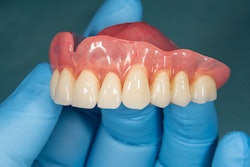
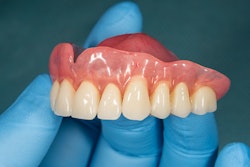
The hub’s core innovation is a new method of printing dentures using 3D inkjet printing, developed in collaboration with dental manufacturer Myerson. Traditional dentures use injection molding and subtractive milling or a single-material process followed by manual assembly. 3D inkjet printing, however, creates a complete denture in a single build within hours.
The novel dentures, which have been cleared by the U.S. Food and Drug Administration, have not yet been evaluated in a clinical trial. But CU Anschutz operates multiple patient care clinics that can serve as a springboard for further studies. That initial blinded clinical trial will compare the inkjet-printed dentures against analog compression-molded prostheses to measure patient satisfaction and outcomes, the university said.
The innovation behind the inkjet-printed prostheses is polymer systems developed by Jeffrey Stansbury, PhD, a professor and the senior associate dean for research for CU Anschutz, that influence denture stiffness, elasticity, and other properties.
The team is also working on solutions for removable partial dentures, where no monolithic, multimaterial 3D-printed solutions exist, CU Anschutz said.
Another innovation involves parallel research from the university’s dental and medical school developing antimicrobial and antifungal materials that can be used to fashion a printed denture itself or used as a coating to prevent infections from Streptococcus species and Candida, which are common among people who wear dentures.
The hub could serve as a research model for other schools, potentially accelerating the path from discovery to patient care.
“The dental world is watching our project,” Stansbury said.