I started with CAD/CAM systems in the late 1990s and stopped using the technology in the mid-2000s, for a variety of reasons. Two of the main reasons were one, the limitations of the materials available at the time, and; two, the cost of frequent upgrades. However, I was convinced it was the future and monitored its progress. I knew at some point I would jump back into this technology, but I was willing to wait for the right time.
After the pandemic, I was impressed with the progress in mill technology and began conducting product evaluations to decide which company and system was right for me. One of the things that stopped me from using CAD/CAM originally, as I mentioned above, was the choice of restorative materials.
Since then, however, lithium disilicate and zirconia came to market and were two of my routine choices for full coverage restorations. I knew many labs produced milled restorations from these materials with great success, and that drove my interest.
 Dr. John Flucke.
I knew that if labs were depending on mills to create restorations, a mill could do the same for me. I am normally cautious with adopting new materials for crowns, but both materials had a strong success record over several years. Add to that, both materials were already being milled, and that made the idea of again doing in-office crowns especially intriguing.
However, there was also the aspect of cash flow to consider. To be viable in an office, technology must provide outstanding clinical results, as well as produce a positive cash flow.
From my previous experience, I knew the costs of milling itself were lower than a lab-fabricated option, but the hardware systems to create them were expensive. When I began to reevaluate in-office milling, the hardware costs had dropped considerably.
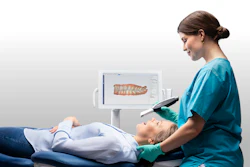
We had been using intraoral scanners for almost 15 years at that point and were comfortable with their use and results. An open-source mill would allow us to pair our existing scanners with the new mill without the cost of buying both. Mills had also decreased in price significantly. Our financial analysis showed a strong positive cash flow. When paired with the excellent clinical results, it was an easy decision.
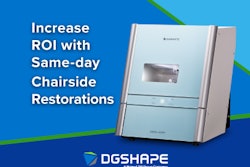
After evaluating options, I brought the DGShape DWX-42W mill into the office in April 2022. I was not disappointed. Efficiency went up, and the team took to it immediately. In fact, I was so pleased with the technology and results that we upgraded to the DGShape DWX-43W mill three years later.
One of my principal rules in bringing technology into my practice is to increase efficiency. By that, I don't mean technology that enables me to work faster, but tech that eliminates steps. I do not want technology to slow us down. I often say that the technology should work for the doctor, not the other way around.
If we can eliminate steps and still get the quality I expect, that makes adoption much easier. I knew in-office milling would give me outstanding results; however, I also knew that having to fire materials in a porcelain oven would have a serious impact on efficiency.
To remove the costs and time of a porcelain oven from the equation, I decided that when milling lithium disilicate or zirconia, we would only use prefired blocks. That decision eliminated the time, effort, and expense required by a porcelain oven. Both materials can be milled in the DWX-43W in 25 minutes or less and polished before cementation. Rather than milling, firing, and finishing, the restoration is ready to polish as soon as the milling is completed. The finishing and polishing are routinely completed in about 10 minutes. Eliminating the oven makes same-day crowns an easily achievable reality.
The materials I use are Amber Mill Direct, from Roland, for lithium disilicate and Chairside Zirconia, also by Roland. Both materials have performed extremely well. Both are highly aesthetic and polish to an exceptional gloss.
For our first 10 milled crowns, I compared our results versus results from a dental laboratory. We sent our first 10 cases to our lab, then fabricated the same case with our mill. I then spent time evaluating both types, both on the model and in the patient’s mouth. What I quickly discovered was that fit, finish, contacts, and occlusion were almost identical.
Patients appreciate the efficiency, and the team loves expanding their skills to include designing and milling. Team members tell me that being more involved gives them greater job satisfaction and allows them to develop new skills. As a doctor, I appreciate both the results and the improved profitability.
The profession is moving toward offering more services created in-office. For offices that have embraced intraoral scanning, I highly suggest considering the next step by bringing many of your crown cases in-house. This is one of those technologies that is easy to adopt and has benefits for everyone involved.
Dr. John Flucke is in private practice in Lee’s Summit, Mo., where he spends four days per week in direct patient care. He currently hosts the Technology Evangelist podcast series. He is a past president of the Greater Kansas City Dental Society as well as serving as the Missouri State Peer Review Chairman.
The comments and observations expressed herein do not necessarily reflect the opinions of DrBicuspid.com, nor should they be construed as an endorsement or admonishment of any particular idea, vendor, or organization.