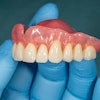
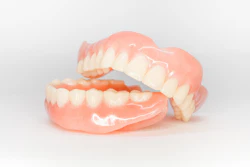
Denture adhesive (DA) may improve the strength of removable partial dentures (RPDs), likely allowing wearers to chew better and have a greater bite force. The study was published recently in the Journal of Prosthetic Dentistry.
Furthermore, DA may benefit patients with extensive RPDs, particularly those wearing dentures on both arches and those who have used their dentures for more than five years, the authors wrote.
“DA can enhance the retention and stability of RPDs for wearers with extensive tooth loss, thereby improving masticatory function in these individuals,” wrote the authors, led by Dr. Xin Shu, PhD, of the University of Hong Kong Faculty of Dentistry in China (J Prosthet Dent, March 4, 2026).
To evaluate how DA affects chewing function in RPD wearers, 83 older adults with extensive tooth loss were asked to use a cream-type DA daily. Participants were recruited from a dental hospital between March 2021 and July 2022. They had either received extensive RPDs within the past five years or were awaiting new ones while wearing existing dentures, they wrote.
Extensive RPDs were defined as dentures replacing all premolars and molars on one or both sides of an arch or dentures in arches with six or fewer remaining teeth. Maximum occlusal force (MOF) and masticatory performance (MP) were measured at baseline, after one week, and after 12 weeks of DA use. MP was assessed with color-changing chewing gum and MOF with an electronic force detector. Also, a heat map was created to visualize changes in MP for each participant.
MOF and MP improved significantly over time (p < 0.001). At baseline, 46.2% of RPDs had satisfactory retention, and 27.8% showed stability, which increased to 98.4% and 90.2%, respectively, after one week of DA use (p < 0.001), with no additional improvement at 12 weeks. Overall outcomes, including MP and both posterior and anterior MOF, improved significantly across most subgroups (p < 0.01), they wrote.
Additionally, the heat map results showed that more than half of participants experienced improved MP, particularly those with poorer baseline performance, although about one-quarter with good baseline MP saw declines after DA use. Improvements were more common among individuals wearing two dentures and those with problematic or metal-base RPDs, with denture integrity (p = 0.037), denture material (p = 0.003), and denture satisfaction (p = 0.032) significantly associated with MP changes.
The study had limitations. The quality of RPDs varied, with about one-fifth showing integrity issues, unlike other studies that only included dentures without noticeable problems, the authors added.
“Since not all participants experienced improvements after DA use, further investigation is warranted, especially for well-fitting extensive RPD wearers and 1-denture wearers,” the research team concluded.