Artificial intelligence systems may serve as efficient and accurate tools for detecting and classifying impacted teeth, allowing for earlier diagnosis. The review was recently published in the Journal of Dentistry.
However, further research may be needed to improve the reliability and transparency of these systems, the authors wrote.
“AI-based diagnostic systems show promising potential in the detection, classification, segmentation and prediction of impacted teeth other than third molars,” wrote the authors, led by Lei Yu of the University Hospitals Leuven Department of Oral Health Sciences in Belgium (J Dent, March 7, 2026, 106612).
To evaluate AI-based approaches for diagnosing impacted teeth other than third molars, researchers searched electronic databases for relevant studies published up to August 2025. Studies were included if they involved healthy patients with impacted teeth and used AI tools for diagnosis. The AI methods were compared with other diagnostic approaches, such as expert clinical judgment and radiographic evaluation, they wrote.
Outcomes included diagnostic performance measures, including sensitivity, specificity, accuracy, and precision. Eligible study designs included randomized controlled trials, observational studies, retrospective cohort studies, or case series with more than six patients. AI applications were categorized by task type, such as detection, classification, segmentation, or prediction.
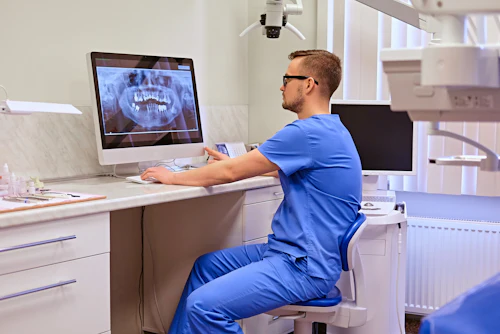
A total of 622 articles were identified through the search, and all included studies published within the last five years. Of the 30 studies included, 15 focused on mesiodens and 15 on impacted canines. Most studies used deep learning-based approaches with dental radiographic images, primarily panoramic radiographs, followed by cone-beam computed tomography (CBCT) and periapical radiographs, they wrote.
Across detection and classification tasks, more than 70% of reported performance metrics exceeded 0.8, with deep learning-based object detection algorithms and deep learning convolutional neural network architecture used most often. Segmentation models also showed strong performance with similarity coefficients frequently above 0.9.
No AI-based diagnostic studies on impacted premolars or incisors were identified, although CBCT-based studies showed strong results for three-dimensional assessment and artificial neural network methods demonstrated moderate to high predictive accuracy for unerupted tooth size.
The review had limitations. Although the researchers examined AI-assisted-diagnosed impacted teeth other than third molars, the available evidence was limited to studies on mesiodens and impacted maxillary canines, the authors added.
“Collaborative efforts between AI researchers, dental specialists and regulatory bodies are essential to translate these technologies into clinically validated, trustworthy, and widely accessible tools for improving the diagnosis and management of impacted teeth,” Yu and the team concluded.