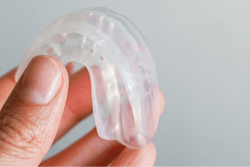
Although patients report that their mouthguards still feel good after wearing them for a year, their fit deteriorates significantly during that time, according to a study recently published in Dental Traumatology.
Not having the right fit may compromise force distribution and energy absorption capacity, potentially leading to dental injuries, the authors wrote.
“Subjective perception alone may not accurately reflect changes in mouthguard fit, highlighting the importance of objective fit assessment during routine sports dental care,” wrote the authors, led by Dr. Tomoya Gonda of the University of Osaka Graduate School of Dentistry in Japan (Dent Traumatol, July 25, 2026).
To explore shifts in fit and user-reported outcomes of custom-made ethylene vinyl acetate mouthguards during one year of athletic use, a prospective longitudinal observational study that included 41 athletes was conducted.
Using a validated intraoral silicone weight method, mouthguard fit was assessed at baseline, six months, and 12 months, and visual analogue scale surveys were used to assess user-reported outcomes.
Over time, the fit-checking material weight rose significantly, representing a 48% relative increase at one year compared with baseline (p < 0.05), signifying progressive loss of fit. However, most athletes reported no changes in comfort or function during those time periods, the authors wrote.
Moreover, the study was not without shortcomings, including its high attrition rate. The results should be interpreted with caution due to the smaller sample size, the authors wrote.
To better understand the longevity and performance of mouthguards, more studies that compare longitudinal changes in the fit and durability of splints should be done in the future, they wrote.
“Within this context, our findings demonstrate that clinically measurable deterioration can develop within 1 year of regular athletic use, even in the absence of perceived functional problems,” Gonda and colleagues wrote.