Starting January 1, 2027, the ADA's Coding Companion changes how dentists classify implant crowns, requiring screw-retained crowns built on lab abutments to be coded as abutment-supported rather than implant-supported, which will affect billing and require practices to report both the abutment and crown separately.
- Effective date: The new implant crown coding definitions apply to all dates of service on or after January 1, 2027.
- Key change: Screw-retained crowns the lab builds on an abutment must now be coded as abutment-supported, not implant-supported, even when delivered as one piece.
- What stays the same: Abutment-supported crowns attach to separate abutments (prefabricated or custom), while implant-supported crowns attach directly to one-piece implants with no separate abutment.
- Action required: Ask your lab to list abutment type on every implant crown slip, report the abutment with the crown using the correct code, and review your fee schedule to avoid double-billing.
- Payer variation: Check each insurance plan's policy, as the Coding Companion is ADA guidance and plans adopt changes on their own schedules.
For years, I taught that a screw-retained implant crown made in one piece is implant-supported, even when the lab builds it on an abutment. I wrote that in my 2022 article on coding implant- and abutment-supported crowns, and it matched the ADA’s Coding Companion at the time. However, starting January 1, 2027, the association’s guidance says the opposite.
This change was not one of the 67 official Code on Dental Procedures and Nomenclature (CDT) 2027 changes. It sits in the 2027 Coding Companion’s definition of an implant-supported crown. I met with dental coding experts Greg Grobmeyer and Rick Garofolo to compare interpretations, and we agree on what it means and how we will teach it.
What stays the same
 Estela Vargas, CRDH.
Choose the code by material, by whether the crown is a single unit, a retainer or a pontic, and by whether it is abutment-supported or implant-supported.
An abutment-supported crown attaches to a separate abutment, either prefabricated (D6056) or custom (D6057). You report the abutment and the crown. CDT describes the crown as “retained, supported and stabilized by an abutment on an implant.”
An implant-supported crown attaches directly to the implant, so there is no abutment to report. CDT describes it as “retained, supported and stabilized by an implant.” Adding an abutment to one of these claims usually gets denied as a miscode.
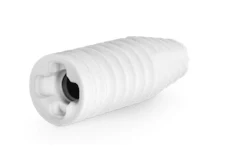
 The 2027 Coding Companion redefines implant-supported restorations. The crown now attaches directly to a one-piece implant, with no separate abutment.Estela Vargas, CRDH.
What changes
The 2026 Coding Companion called a crown implant-supported if it reached the mouth as one piece. A lab-built abutment counted as part of the manufacturing process, so the lab bill could list an abutment, and you still reported only the crown. Many offices ignored that and billed the abutment anyway. Some payers audited those claims and took the payments back.
The 2027 Coding Companion moves the line. Implant-supported now means the crown attaches directly to a one-piece implant with no separate abutment, whether the abutment is made in the lab or placed in the mouth. The ADA’s examples are mini-implants, monotype implants, and other one-piece implant bodies. A Q&A in the Implant Services chapter repeats the point and names the lab step directly.
A screw-retained crown the lab builds on an abutment is now abutment-supported. Cemented crowns already were abutment-supported. Implant-supported is limited to crowns on one-piece implants, with the abutment built into the implant post, which is a small share of what most offices place.
| Crown type | Through 2026 | 2027 and after |
|---|---|---|
| Cemented crown on a separate abutment | Abutment-supported | Abutment-supported |
| Screw-retained crown the lab builds on an abutment, delivered as one piece | Implant-supported, no abutment reported | Abutment-supported, abutment reported |
| Crown on a mini or monotype implant with the abutment built into the implant | Implant-supported | Implant-supported |
What to do now
- Apply the new definition to dates of service on or after January 1, 2027. Dates of service in 2026 stay under the 2026 manual.
- Ask your lab to list the abutment type on every implant crown slip and record it in the chart. Most labs are already doing this.
- Report the abutment with the abutment-supported crown, using the prefabricated or custom code that matches what the lab built.
- Review your fee schedule. If you raised your implant-supported crown fee to cover a lab-built abutment, reset it so the crown and abutment fees are not covering the same cost.
- Check each payer’s policy. The Coding Companion is ADA guidance, and plans adopt changes on their own schedules.
Code what you do. If the crown you seat has a separate abutment under it, report both.
Editor's note: References are available upon request.
Estela Vargas, CRDH, is the founder and CEO of Remote Sourcing, a dental insurance billing and revenue recovery service. She is a graduate of Miami Dade College's dental hygiene program. Vargas' extensive background in the clinical arena of dentistry is coupled with her experience as a practice administrator and business executive.
The comments and observations expressed herein do not necessarily reflect the opinions of DrBicuspid.com, nor should they be construed as an endorsement or admonishment of any particular idea, vendor, or organization.