Researchers at the University of Basel in Switzerland have developed a miniature dental robot designed to prepare teeth for crowns, potentially reducing the number of appointments required for treatment, according to a news release.
Furthermore, the small robot may improve patient experiences by streamlining crown preparation, according to the release dated June 23.
“It is designed to be small enough to fit comfortably into an open mouth,” Dr. Yukiko Tomooka of the university’s department of biomedical engineering and lead author of the study, said in the release.
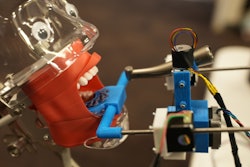
The researchers developed a prototype called the miniature intraoral robot (MIR) that may simplify the caries treatment and crown prep process. After a digital scan, dentists can create a treatment plan that allows the robot to prepare the tooth with precision while the permanent crown is ordered immediately, according to the release.
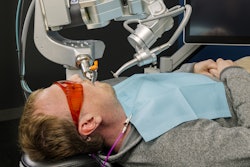
The compact robot is about the size of a wine cork. Its motors and control system are positioned outside the mouth and connected through flexible drive shafts, cables, and tubes. The team tested the device on synthetic resin tooth models and ceramic material with a hardness like natural tooth enamel.
 A miniature robot developed at the University of Basel could help prepare teeth for a crown.University of Basel/Catherine Weyer.
The robot prepares teeth in two stages. First, MIR uses a larger drill to reduce the tooth surface before, second, switching to a thinner drill to shape the sides. Despite operating without built-in position sensors, the prototype achieved a positional error of less than 0.2 millimeters, according to the release.
The researchers expect even greater accuracy after sensors are added. Additionally, testing showed that drilling forces remained below 5 N. Researchers continue to evaluate the robot's noise levels to determine its suitability for use in dental practices.
Further research is needed before MIR can be used clinically, including adding sensors and a camera to monitor its positioning and treatment progress without increasing device size, according to the release.
“Even after a power outage, MIR would know where it is and where it needs to continue based on the sensor data,” Georg Rauter, professor at the university and research lead, added.