It's true that 3D printers are not yet the standard of care, but the future is near. According to recent research, the dental 3D printing market in the U.S. is expected to grow at a compound annual growth rate of 26.2% by 2030. The key markers for this growth stem from the demand for personalized treatments, cost efficiency, faster workflows, and new biocompatible materials.
As 3D scanning and printing move into more practices, a coding gap is emerging. The CAD and CAM steps that used to happen in a lab (and carried separate lab fees) are now performed in-house. Many practices bundle this work into existing procedure fees and sacrifice revenue. This article walks through the CDT (Code on Dental Procedures and Nomenclature) codes that apply to each phase of the digital workflow.
Itemizing the digital workflow
 Estela Vargas, CRDH.
The ADA’s 3D Printing Guide describes the clinical workflow in five steps: scan, design, print, process, and deliver. For billing purposes, those clinical steps are grouped into three reportable phases: data acquisition, CAD, and CAM.
CAD and CAM represent professional and technical work that previously occurred in a lab and carried a separate fee. When those steps move in-house, the value does not disappear.
Note on reimbursement: Most dental policies do not cover these services. Fee-for-service practices can charge them to the patient as necessary professional services. In-network providers must first check their preferred provider organization agreements, as some contracts restrict patient billing for non-covered services.
Phase 1: Digital acquisition
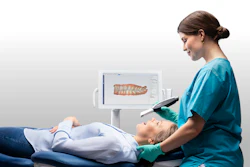
Every capture during this phase is reportable: cone-beam computed tomography (CBCT), intraoral scans, scans of existing models, and 2D photographic documentation. Many practices bundle them into a single fee and sacrifice revenue.
For surface scans, “direct” means the patient is present, and the image is captured by directly scanning the patient’s features. For D0801, this means the scanner is in the patient’s mouth. “Indirect” means the image is captured by scanning a previously created model, such as a diagnostic cast. Dedicated CDT codes exist for this phase:
- 10 CDT codes describe CBCT scans: five for image capture with interpretation and five for image capture only. Refer to the CDT manual for descriptions.
- Use D0801 3D intraoral surface scan - direct whether you're scanning a quadrant, arch, or the entire mouth.
- For scans of a physical model using a scanner or a CT machine, use code D0802 3D dental surface scan – indirect.
- Use D0350 for 2D oral/facial photographic images obtained intraorally or extraorally.
Note: D0351 (3D photographic image) was deleted as of January 1, 2023, and replaced with the current surface scan codes. Update any claim templates still using D0351.
Phase 2: Virtual treatment planning (CAD)
Virtual planning is another area where value is lost. The time spent manipulating a 3D dataset, assessing anatomical limitations, or planning implant placement has its own code because it represents professional work that directly informs treatment.
- D0393 virtual treatment simulation using 3D image volume or surface scan: This code documents virtual treatment simulation for procedures including but not limited to dental implant placement, prosthetic reconstruction, orthognathic surgery, and orthodontic tooth movement.
- D0395 fusion of two or more 3D image volumes of one or more modalities: This code applies when you're combining multiple 3D datasets, such as merging a CBCT volume with an intraoral surface scan for implant treatment planning. The fusion itself is reportable work, separate from the underlying captures.
Phase 3: Fabrication of the physical output (CAM)
Fabrication of the physical output is equally important. A surgical stent for soft-tissue healing is not the same as a radiographic index for implant planning, and neither should be reported as an unspecified service (DX999) when a defined CDT code exists.
When no specific code applies, the appropriate unspecified code may be used supported with a clear narrative describing the appliance’s purpose and design. Consider the following:
- D0396 3D printing of a physical model derived from a surface scan: Used for printed study models, orthodontic analysis, occlusal evaluations, and maxillofacial prosthetics. This item helps recoup material and equipment costs. In-network providers, please note that some plans may consider this fee included in other procedures.
- D6190 radiographic or surgical implant index, by report: This item is for appliances that relate osteotomy or fixture position to existing anatomic structures, such as those used during radiographic planning and osteotomy creation. It may be reimbursable when the policy includes implant benefits, depending on the carrier.
- D5982 surgical stent for soft-tissue healing: This item is used for stents that apply pressure to soft tissues to prevent collapse during healing. It is not appropriate for radiographic or surgical guides.
- D5988 surgical splint: Use this code for devices that use existing teeth or alveolar processes as anchors to stabilize broken bones during healing. It is, however, not appropriate for implant positioning guides or radiographic indexes.
Documenting the workflow
Documentation is the final piece. Notes must justify the need for the service, link the diagnosis to the procedure, and demonstrate why simpler alternatives were not adequate. When the documentation captures the scan, the planning, the printed output, and the clinical procedure that followed, the claim stands on solid ground.
Coding each phase, rather than bundling the work into a single procedure fee, turns what used to be lab invoices into captured in-house revenue. The codes exist, and the documentation is straightforward. What remains is applying them consistently.
Editor's note: References available upon request.
Estela Vargas, CRDH, is the founder and CEO of Remote Sourcing, a dental insurance billing and revenue recovery service. She is a graduate of Miami Dade College's dental hygiene program. Vargas' extensive background in the clinical arena of dentistry is coupled with her experience as a practice administrator and business executive.
The comments and observations expressed herein do not necessarily reflect the opinions of DrBicuspid.com, nor should they be construed as an endorsement or admonishment of any particular idea, vendor, or organization.