Since the debut of ChatGPT in 2022, artificial intelligence has been a hot-button topic in both business and general society. Many industries have eagerly adopted AI tools and platforms, and the category only keeps growing. Just last month, Gartner projected 63% growth in AI from 2025 to 2026, with some specialized models jumping as much as 210%.
Although the dental industry was long neglected by Silicon Valley and big software, there has been a growing movement in recent years to adopt cloud-based software as a service platforms and, increasingly, AI Many dental practices that may not have seen a reason to switch from trusted legacy vendors or even old-school pen-and-paper methods now have one: the productivity benefits of AI. In fact, the ADA's second quarter State of the U.S. Dental Economy report found that 2 in 5 dentists use AI in their practice today.
 Dr. Rania Saleh, MSD.
And yet, much of this use is for administrative work, such as insurance verification. There remains a gap in just how far dentists are willing to trust AI clinically.
I've heard this on the ground at Oryx, where dentists report that their peers view AI tools with not just suspicion, but even offense. After all those years of dental school and hands-on experience, being replaced by a machine feels like an insult.
The ADA's summer report backs up our anecdotal experience: The majority of respondents (82.6%) said they don't use AI for patient treatment recommendations and weren't planning to, either, while another 68.3% said they do not use -- and don't plan to use -- AI to explain their findings to patients either.
But the truth is that AI isn't an insult to dentists' clinical skills. It's complementary.
Imagining the best clinical assistant possible
In the past, dentists might have relied on a dental hygienist or dental assistant to support those same decisions. But in an economy where hiring these specialized roles has been difficult for years, AI can fill the gaps.
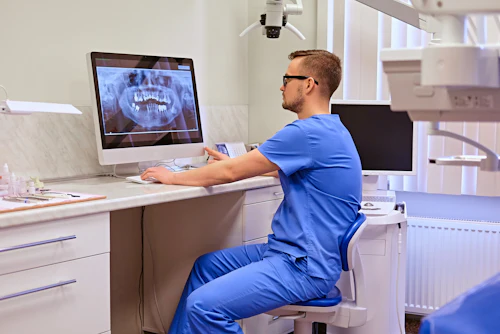
This is not to say that AI tools for clinical use are not valuable and that they can't catch things that people might miss. Rigorous, U.S. Food and Drug Administration-cleared solutions exist for imaging, for example. These tools can help busy clinicians by catching issues and flagging them for review.
But that's the point. The AI is not in charge. Its judgment is not "better" than the clinician's. Rather, the AI is simply helping a dentist find and document the state of a patient's mouth.
Clinical-support tools may take and summarize notes, allow clinicians to probe and chart at the same time, or provide documentation for the team to make treatment recommendations. Regardless, it's the clinician, in the end, who brings to bear their decades of training to assess, interpret, and act on information.
Patients thrive with more information
While many dentists may feel that they don't want to use AI for treatment recommendations or patient education, these are, ironically, areas where these tools could help. Of course, the clinician must assess and approve everything -- AI makes mistakes. However, there is so much to be gained from better educating patients on the state of their mouth, how it contributes to or is part of their broader health, and what their options are.
Running my own multisite practice, I saw firsthand the power of information. Long accustomed to being talked down to, my patients were thrilled to receive printed reports, charts, and summaries of their oral health. They didn't want to feel that expensive treatments were being pushed on them. They wanted to understand what I found, what we could do about it and, importantly, why. Information turned the relationship from a hierarchical doctor-patient dynamic to something more powerful: a partnership.
That was years ago, far before the advent of AI (and a huge part of why I founded Oryx Dental in 2016). Today, dentists are lucky. Whereas I once stayed up late making custom reports for patients by hand, AI can now help dentists provide this same partnership more easily. By using AI to help them showcase options or explain findings in plain English, they can help patients make the right decision for their oral health.
AI will become a normal part of the dental toolkit
In the ADA's recent report, 17.7% of respondents agreed that AI is a tool and that it should not replace clinical judgment. I couldn't agree more.
The goal of AI in dentistry is not to replace the human element but to enhance it by taking away elements that are tedious or that take time away from where dentists truly want to be: chairside with patients. Because let's face it, no one went to dental school because they love doing charts.
No matter what, AI is here to stay and development is only accelerating. New generations of dental hygienists, dental assistants, practice administrators, and doctors are being trained on and rely on AI every day. Soon, AI tools will become just as standard in dental care as mouth mirrors, scalers, and sickle probes.
Editor's note: References are available upon request.
Dr. Rania Saleh, MSD, is the founder and CEO of Oryx dental software. Prior to starting the company, she was the founder and owner of a multisite dental practice in the Washington, DC, area. Saleh attended McGill University, where she received both her Doctor of Dental Surgery and Master of Science in Dentistry degrees.
The comments and observations expressed herein do not necessarily reflect the opinions of DrBicuspid.com, nor should they be construed as an endorsement or admonishment of any particular idea, vendor, or organization.