Daniel Scavilla and Aldo Denti don't come from dentistry. They come from decades of medtech -- Johnson & Johnson, spine surgery, high-stakes commercial turnarounds -- and they arrived at Dentsply Sirona with a specific mandate: re-earn the company’s right to lead in the dental industry.
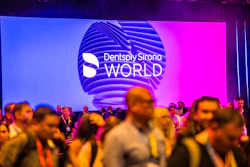
I sat down with the company's president and CEO and its chief commercial officer on June 26, 2026, at the company’s Implant Solutions World Summit in Gothenburg, Sweden, a gathering of more than 1,000 clinicians from around the world. What followed was a candid conversation about artificial intelligence, workflow, the workforce shortage, and what it actually takes to rebuild a market leader from the inside out.
Kevin Henry: Dan, you spent 28 years at Johnson & Johnson and then led one of the largest spine technology companies in the world before joining Dentsply Sirona. What did you see in dentistry that made this the right next move?
 Dentsply Sirona CEO Daniel Scavilla.Dentsply Sirona.
Daniel Scavilla: I genuinely love medical devices and pharmaceuticals -- that sense of having a skill set you can use to help thousands of people. For me, moving into this industry was a new platform to grow personally and learn.
When I first met the company and saw the products, I was struck by the customer loyalty, which I think is incredibly strong. Then I saw the opportunity to improve things by getting back to some basics -- things that Aldo and I have done together in the past. It was a great personal challenge: a chance to grow into a new industry, help people, and apply skills from the past to take a great company and make it even stronger.
Dentsply Sirona has an enormous portfolio -- endodontics, implants, orthodontics, digital dentistry, CEREC, and more. How do you think about focus and prioritization when you’re the world’s largest dental products company and you make nearly everything?
Scavilla: We are very focused on sequencing. If you tried to do everything at once, you’d end up being great at nothing. We challenge ourselves as a team: Are we prioritized correctly? Are we moving in the right direction? Are we spreading too thin? That discipline keeps us grounded.
Aldo Denti: When you come into a complex organization with a significant global portfolio, things can feel overwhelming. The first task of any new management team is to make the complex simple.
We focused on two parallel tracks: the external factors -- primarily the relationship with dental professionals -- and the internal factors that drive how the organization operates. On the commercial side, we identified where we wanted to focus. Internally, we looked at what needed to move. Together, those two tracks pointed us toward a clear priority: transitioning to a new way of engaging with customers. We call it the customer experience, and it has both an external and an internal component.
The most important rule in any turnaround is to make the complex simple, focus on a few things, get those done, and then move to the next batch.
Scavilla: One more piece of that: You have to have the right people around you. Trust them, hold them accountable, and let them go do their work. Divide and conquer. Otherwise, you can never cover something that large.
How does a meeting like this fit into your plans and vision for where Dentsply Sirona is going?
Denti: If you want to be the No. 1 dental company in the world, you have to have strength in implants. It’s one of the key pillars. But for us, it’s not just about the implant itself, it’s about looking beyond it. You’re building an ecosystem that spans the restoration, the abutment, the implant, and the science behind it. That’s where we see significant potential, because our portfolio can span multiple components.
This meeting is a continuation of our scientific congress offering -- following events in Athens in 2023 and Miami in 2024, to showcase our implant technology at this scale -- and also begin to wrap in everything else the company brings. Digital workflow is a good example. It’s not just about the implant, it’s about the entire workflow that makes a dental office more efficient. Efficiency in dental offices is paramount right now.
Scavilla: The other thing this gives us is a very diverse voice of the customer. We hear from distributors worldwide, from direct customers in the U.S. versus Spain. It’s a great way to triangulate -- to find out whether what we’re hearing is consistent across markets or unique to a particular region.
Denti: And similar to other medtech businesses: In the end, what are we here to do? We’re here to empower dental professionals to provide the best possible care for their patients. This is a relationship business.
We’re building long-standing clinical partnerships because we need the insights to develop the best possible products. You can’t do that from an office in Charlotte (where Dentsply Sirona is headquartered in the U.S.). You have to get out into the field, listen to clinicians, and understand how to actually achieve that. When you have more than 1,000 people in a room, the voice of the customer doesn’t get much better than that.
I keep hearing that live dental shows are dying and we’ve entered the age of virtual learning. With this meeting, you’re kind of proving that wrong, correct?
Scavilla: Nothing replaces face-to-face contact. Virtual tools are a booster shot -- they enhance in-person connection, they don’t replace it. If you rely solely on virtual, you’ve fully removed yourself from the customer and the experience. You have to be front line, especially in something evolving at this speed.
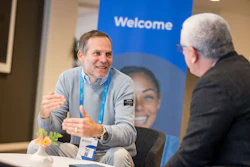
 Aldo Denti (left) answers questions from DrBicuspid.com's Editor-in-Chief Kevin Henry (right).Dentsply Sirona.
Denti: When a clinician is evaluating a new technology, it’s a multiphase journey. It might start with a relationship, then a meeting where they engage with the science. The next step might be hands-on experience. After that, actually getting the equipment and trying it in practice. Virtual can support parts of that journey, but it can’t deliver the full flow from idea to adoption.
There are questions a virtual meeting simply can’t answer: Does this fit into my practice? Is it efficient enough? Those conversations require direct engagement. Virtual is a powerful tool, but it’s one of many.
There’s also another dimension: It gives clinicians a chance to see who we are.
Scavilla: There’s real power in numbers when people come together. You see the scale of what’s happening and think, "I didn’t realize how significant this is." You can’t replicate that virtually. Call it old school -- I’m all for it.
When I think of Dentsply Sirona, workflow always comes to mind. Now we have AI in the picture. How do you see AI fitting into what you do and into the practice workflow?
Scavilla: Let’s start at the R&D level for us. AI can accelerate innovation by running multiple iterations simultaneously, giving you more turns at bat at a faster pace. Then you bring it into everything we talked about with implants — we have over 3,000 studies in our database. You can use that entire body of data to run algorithms and probabilities, harvesting insights that would take years to surface manually.
AI can also flag potential problems in imaging, not replacing the clinician’s judgment but surfacing things worth a second look. I’m a firm believer that the practitioner should be the ultimate decision-maker, not a machine.
I’ll be honest: We’ve intentionally held off on broad internal AI applications. We don’t want every department running in different directions. Right now, it’s focused on R&D; over time, we’ll layer in more.
Denti: The term AI gets misused a lot, so I think of it in three distinct categories.
The first is external clinical applications -- AI as an enabler. It gives clinicians information faster so they can make better decisions. We’re looking at how to make our products enhance the clinical outcome from that lens.
The second is internal development. AI can significantly accelerate how we bring software products to market -- the speed of programming is simply different than what was possible before.
The third is internal efficiency -- using AI to make organizational processes faster. I have examples where we took a process from six weeks to six minutes with less human intervention. That frees people up to do higher-value work.
We’re working on all three simultaneously. The most advanced application right now is accelerating how we build software, but all three are active.
Stanley Bergman of Henry Schein raised a concern at the last IDS meeting that the next generation of dentists might rely too heavily on AI. You’ve said you want the human to be the final decision-maker. Is overreliance a real concern?
 Dan Scavilla (second from left) and Aldo Denti (second from right) answer questions from DrBicuspid.com's Editor-in-Chief Kevin Henry (right).Dentsply Sirona.
Scavilla: It’s a real possibility. Which is why it becomes the responsibility of universities, dental schools, and continuing education programs to ensure that clinicians understand the science and can make informed decisions, using AI to augment their speed and data input, not to replace their judgment.
The danger is when AI makes the decision rather than informs it. When I was in the spine industry, I always thought about it this way: If I were having spine surgery, I’d want a robot involved, but the surgeon using it had better know how to do it manually.
Denti: Same answer as before: AI is an enabler and a decision-support tool. It’s not the decision-maker. It brings complex datasets into focus so the clinician can say yes or no with more confidence. But someone still must make that final call. The clinician treating the patient cannot be replaced. That relationship can be augmented by tools, but it can’t be handed over to them. There is a fine balance, and it must be maintained.
The dental workforce shortage is real and said by experts to not be going away anytime soon. What role does the industry -- and maybe Dentsply Sirona specifically -- play in addressing it? Or does the industry have a role in this?
Scavilla: There’s definitely a role. When you look at where digital dentistry and seamless workflows are going, all of it is driven by efficiency without sacrificing efficacy or the patient experience. AI has a part in that, creating a flow that requires less human effort to support the dentist, which is one way to genuinely help address the shortage.
Denti: It comes back to efficiency. We know there’s a problem, and as a leading dental company, we have to lean into helping clinicians work more efficiently. The tools we’ve seen drive transformational change in other medtech sectors -- orthopedics and others -- are no different here. Can we reduce time while preserving outcomes? That’s the question we must answer.
But there’s another obligation as well. As a company like Dentsply Sirona, we have to help staff up the profession. Clinical education is one of the pillars of any successful medtech company, and it doesn’t mean education only for dentists. It means everyone who touches a dental practice: administrators, dental hygienists, dental assistants, dentists, specialists, and labs. There is an entire ecosystem that we have a responsibility to train. That’s not optional for a company in our position.
There’s a common perception that dentistry lags behind medicine in technology adoption. Having come from the medical industry, have you seen evidence of that?
 Dentistry is undergoing a transformation, Aldo Denti told Kevin Henry, much like orthopedics, a once-manual field reshaped by robotics. “I believe the same is happening here,” Denti said.Dentsply Sirona.
Denti: I can give you specific examples where dental was at the forefront of technology development that was later adopted by medicine. Polymethyl methacrylate, or PMMA, was first used in dental and then applied in orthopedics. Hydroxyapatite coatings in orthopedics, now considered the standard of care, were first pioneered in dental. The ability to transfer technology across sectors runs in both directions, and dental has led in meaningful ways.
If you look at our advanced imaging capabilities, there are many potential applications in orthopedics -- craniofacial imaging that could help with maxillofacial reconstruction. We have tools that are extremely sophisticated.
I don’t believe dental is behind. Every organization goes through waves of innovation. Would I say dental is in the middle of an innovation transformation right now? Yes, the way we used to work is changing. But what that transition is going to produce is another burst of innovation. Orthopedics went through the same thing: a very manual field that was transformed by robotics. I believe the same is happening here.
Scavilla: I don’t think I can add a thing to that. That’s some passion right there.
We aren’t far from the end of the decade. If we’re back here in 2030, what do you hope has changed -- for Dentsply Sirona and for the industry?
Scavilla: For us, what I want to see is that we’ve earned back the right to be a market leader. We move fast, we invest in the right things, we keep the customer at the center of everything, and we bring forward meaningful innovation. That’s the baseline, and we have to get better at delivering it.
As for the industry, the dental office in 2030 is going to look very different. AI will be woven into it the way smartphones are today -- a natural part of how things work, not something you have to think about. I also genuinely believe there will be robotic activity in dental practices for certain procedures. And there will be more ways to treat patients efficiently so that the care experience improves for everyone.
Denti: I completely agree that we have to re-earn our right to be the world’s leading company. That’s OK -- we’re on the path, and we’re taking it seriously.
If I fast-forward and think about what that looks like: The digital workflow you see today, while impressive, is still quite complicated. There are many pieces that have to come together, and the experience of weaving them isn’t seamless yet. The dream is to make that genuinely simple, where the clinician isn’t spending time moving between software systems, trying to integrate tools, but instead has a truly connected workflow that cuts time and produces better outcomes.
The second thing is addressing the fragmentation in how we think about clinical applications. A restoration, an implant, an abutment, the workflow -- they’re all divided into separate purchasing components. The industry needs to start thinking in terms of the final clinical construct rather than individual parts. That’s a shift that will benefit everyone, and it’s one we have to help lead.
You’ve both mentioned earning things back within the industry for Dentsply Sirona. What is the biggest hurdle you see in getting there?
Scavilla: Mindset and bringing in the right leaders to shift it. The reason we’ve brought in people with a strong medtech background is that medtech companies are aggressive. They have to be. We fought each other for decades to win business, and that hunger -- that need to move -- is what we’re injecting into this organization.
Do I feel good about the leadership team we’ve built? Yes. Do I feel good about the commercial teams? It’s one of the best I’ve seen. Now we have to drive that same energy through the rest of the organization so that whether you’re in finance, legal, or any other function, when a question arises that impacts a customer, you answer it immediately. That accountability to the person in the chair, and the urgency to act, is what we’re working to instill.
Denti: When I think about medtech companies that truly stand out -- whether in orthopedics, cardiology, or dental -- there are four things that have to come together.
First, the best-trained clinical sales force in the world. You have to set the standard for how your reps are prepared.
Second, fast, game-changing innovation that genuinely meets customer needs, not the needs of the company. It has to be customer-focused.
Third, an internal customer experience that is absolutely seamless. When people think about delightful commercial experiences, they think of Amazon. We have to create that same standard.
Fourth, clinical education that elevates the clinical outcome. You can’t have great innovation and a strong sales force without education that matches it.
We’re working on all four simultaneously. When we get those things right, we’ll have what the best companies in this space have. That’s the standard we’re holding ourselves to.
The comments and observations expressed herein do not necessarily reflect the opinions of DrBicuspid.com, nor should they be construed as an endorsement or admonishment of any particular idea, vendor, or organization.