There is a version of this conversation that exhausts every clinician who hears it: AI and technology will transform your practice. The future is here.
You've heard it before. And if you've been practicing for any length of time, you know what usually follows: a new tool, a new login, a new workflow to manage on top of the ones you already have. That is not what I want to talk about.
The technology being built into modern dental platforms today is designed around a different premise. Not to automate clinical judgment -- which belongs to the clinician -- but to remove the administrative weight that prevents clinicians from exercising it fully. Documentation that writes itself. Images that surface findings before a second look are needed. Charting that keeps up with the exam instead of waiting until after it. These are not features. They are the conditions for better care. And the data now tell us exactly how much that matters.
What the numbers actually say
 Dr. Ryan Hungate, MS.
The 2026 Catalyst Index -- drawn from data across thousands of solo and small group practices -- found that clinical consistency is the single most important driver of practice performance, not collections efficiency, not scheduling volume, and not the number of tools in your stack.
The gap between average practices and top performers is not subtle. Top-performing practices in the one- to seven-location segment achieved a 75% case acceptance rate compared to 42% for the average practice. Their perio-to-prophy rate is 49%, more than double the 19% industry average. Adult fluoride rates follow the same pattern: 60% among top performers, 18% across the field.
At the production level, top practices generate $17,156 in gross daily production -- nearly double the $8,755 average. These are not marginal differences; they are structural ones. And they do not originate in the back office. They come from what happens at the chair.
When diagnoses are consistent, documentation is complete, and patients understand their treatment, more care is delivered. And this results in more revenue generated and collected.
What gets in the way
The problem has never been clinical intent. Most clinicians know what thorough care looks like. The challenge is the administrative overhead that competes for the time and attention required to deliver it.
Think about what a packed schedule actually looks like in practice. A hygienist finishing her notes from the previous patient while the next one is already in the chair. A provider who spotted early-stage perio but didn't have time to walk the patient through what it means. A treatment conversation that was shortened because the next room was waiting.
When schedules are packed and documentation needs to happen, providers are forced to prioritize the immediate need. This is exactly what the data reflects.
The 2026 Catalyst Index found that practices scheduling appointments to give providers the capacity to fully assess and communicate -- not just complete the visit -- consistently outperform those that do not. The difference is not clinical skill. It is clinical capacity.
That capacity is not created by working longer hours. It is created by removing the work that should not require a clinician in the first place.
What intelligent systems actually do
Well-designed clinical technology does not make decisions for clinicians. It provides support for clinical decision-making.
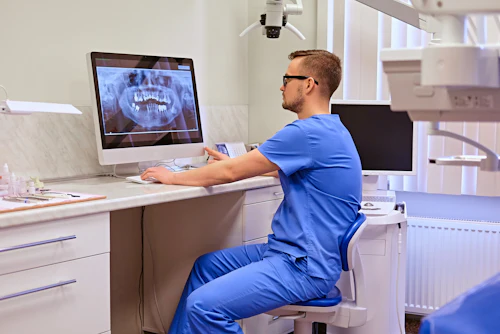
Imagine a provider who finishes a perio exam and, instead of turning to enter notes, stays focused on the patient. The chart is already written. The imaging has flagged a finding worth discussing. The patient's out-of-pocket estimate for treatment is on the screen. That is a real scenario today.
Ambient documentation tools capture notes as the exam happens so providers stay present with the patient instead of turning to a screen. AI-assisted imaging surfaces findings in real time, supporting consistency across providers and visits. Connected workflows ensure that what happens clinically flows into documentation and billing without manual hand offs.
The result is not a different kind of dentist. It is a clinician with more capacity, more time for the conversations that build trust, more attention for the findings that matter, and more consistency in how care is identified and communicated.
That consistency is what builds the patient relationship. And the patient relationship is what drives case acceptance.
Patients don't reject treatment because they don't need it. They delay it when they don't trust the recommendation or can't see a clear path to afford it. Consider the patient who has been coming to your practice for three years. She trusts you. When you show her the imaging, explain what you're seeing, and her insurance is already verified, so you can tell her exactly what she'll owe -- she says yes. That conversation only happens when the systems around it don't get in the way.
Consistent clinical quality addresses the trust problem. Clear, honest chairside conversations about coverage and out-of-pocket costs address the affordability problem. When both are present, patients move forward.
The 33-point gap in case acceptance between top performers and the average isn't a sales problem. It's a systems problem. Top practices have built the conditions where trust can form and financial clarity exists before the patient has to decide.
The real question
The practices winning in dentistry today are not the ones that have added the most tools. The data is clear on this point: Simplicity and connected systems, not additional complexity, define top performers. More tools do not produce better outcomes. Better-connected workflows do.
Every clinician I studied with went into dentistry to deliver good care. The frustration is not a lack of skill or commitment. It is the gap between the care they intend to deliver and what the environment actually allows.
Technology that removes paperwork, supports documentation, and surfaces clinical context at the right moment is not replacing that intention. It is giving it room to operate.
Consistent clinical quality drives growth. But not because it fills schedules or optimizes workflows. Because it builds trust, and when trust meets affordability, patients say yes.
As chief clinical and strategy officer, Dr. Ryan Hungate, MS, leads Henry Schein One’s revenue cycle management automation and One Platform strategy. Hungate is the founder of Simplifeye Inc. and an orthodontist. Prior to pursuing dentistry, Hungate worked for Apple designing the Apple retail workflow.
The comments and observations expressed herein do not necessarily reflect the opinions of DrBicuspid.com, nor should they be construed as an endorsement or admonishment of any particular idea, vendor, or organization.