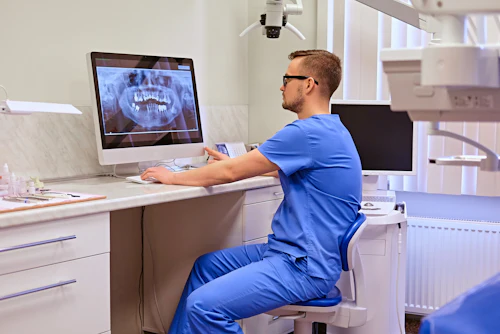
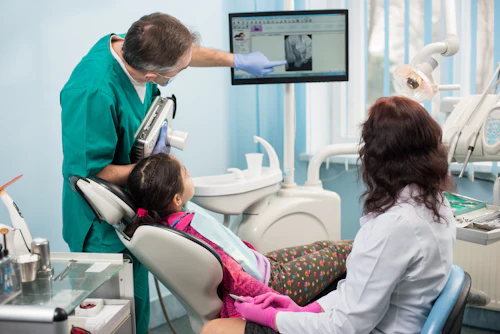
Most conversations about AI in dental practices start with what the software can do. Fewer start with a more useful question: Does it actually make the workday easier for the people using it?
A tool can be technically impressive and still fail in a real office if it does not fit how a dentist, assistant, or front-desk coordinator actually works. This piece looks at the everyday areas that matter most when evaluating an AI operations tool.
Patient communication should feel human, not automated
 Inger Sivanthi.
Patients expect quick responses, whether they are confirming an appointment, asking about a treatment plan, or checking a billing question. Automated texting and chat tools can help by handling routine questions and freeing up staff for more complex conversations.
But the real test is not whether the tool can send a message. It is whether that message sounds like it came from the practice and knows when to hand a conversation off to a person.
Before adopting a communication tool, consider:
- Does it recognize when a question needs a human response, such as a nervous patient or a complaint?
- Does the tone match how the practice actually talks to patients?
- Can staff easily review or override an automated response before it goes out?
Scheduling AI should follow your practice’s rules
Scheduling is one of the most visible places AI shows up, through online booking, automated reminders, or voice-based call handling. The value is real when a tool reduces no-shows and cuts down manual rescheduling work.
The friction shows up when a tool does not integrate cleanly with the practice’s existing calendar, misreads a patient’s name, or ignores provider-specific rules, such as buffer time between certain procedures. A scheduling tool should be judged on how well it fits the practice’s actual booking logic, not how smooth the demo looks.
Documentation AI should support clinical judgment
AI tools that assist with charting notes or record organization can meaningfully cut down on after-hours paperwork. The key question is accuracy and control.
- Does the tool draft documentation that still needs a clinician’s review, or does it present output with false confidence?
- Does it save more time than it costs in corrections afterward?
- Does it support the person charting rather than trying to replace their judgment?
Insurance verification requires more than automation
Insurance verification remains one of the heaviest administrative burdens in dental offices. Spending on eligibility and benefit verification rose 15% to $2.1 billion in 2023, according to the CAQH (the Council for Affordable Quality Healthcare) Index, as reported by ADA News, a clear sign of how much manual effort still goes into this task. Much of this cost traces back to incomplete data shared between payers and practices, not staff error.
The ADA has noted that providers often cannot get reliable enough information through standard automated transactions, which forces offices back onto slower manual portals. This matters for any AI tool built to handle verification, since a tool automating the process without addressing the underlying data gaps will only go so far.
A peer-reviewed study analyzing a large dental insurer’s claims data found that administrative errors, not clinical issues, accounted for nearly 73% of all denied claims. That means the biggest opportunity for AI here is catching documentation mismatches before submission, not just speeding up an already unreliable process.
The ADA also recommends verifying coverage on the actual date of service, since retroactive eligibility changes can trigger recoupment demands later. A good tool should support this rather than replace it with a one-time check.
Thoughtful follow-up builds better patient relationships
Recall reminders, post-treatment check-ins, and reengagement for quiet patients are areas where AI can add consistency that manual follow-up often lacks. The risk is impersonal or poorly timed outreach, particularly after a procedure that required sensitivity.
Good follow-up tools should let staff adjust:
- Tone, especially after a difficult diagnosis or complex treatment plan
- Timing, so reminders do not clash with a patient’s recovery period
- Frequency, so patients are not overwhelmed with repeated messages
The best AI is the one your team actually uses
This is often the most overlooked factor and the one that decides whether a tool actually gets used. A system that requires extensive training or adds extra steps to an assistant’s routine will get quietly abandoned, no matter how capable it is on paper.
Before adopting any tool, ask the people who will use it daily -- not just the practice owner -- whether it fits naturally into their workflow. A tool only the most tech-comfortable staff member can operate confidently is not a practicewide solution.
Successful AI adoption depends on implementation
Rolling out any new system takes real planning. Consider these factors before committing:
- Data migration and integration with existing practice management software
- Staff training time and a transition period where old and new processes run side by side
- Data storage, access controls, and vendor accountability, since any tool touching patient records is handling protected health information under HIPAA
These questions belong at the start of the evaluation, not raised after the system is already live. The right AI reduces work instead of moving it around
The most useful question a dental team can ask about any AI tool is simple: Does this reduce the total work and friction across the practice, or does it just move the same tasks somewhere else while adding something new to manage?
Judged this way, the tools worth adopting are the ones that fit into how a practice actually runs day to day, chosen with input from the staff who will use them, not presented to them after the fact.
Inger Sivanthi is CEO of Droidal, a healthcare AI company focused on improving revenue cycle management and operational workflows for healthcare and dental organizations. Sivanthi's work focuses on responsible AI adoption, practice efficiency, workflow design, and reducing administrative burden for care teams.
The comments and observations expressed herein do not necessarily reflect the opinions of DrBicuspid.com, nor should they be construed as an endorsement or admonishment of any particular idea, vendor, or organization.