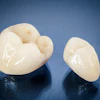
Midas Restore, a 3D-printed ceramic-filled resin, successfully replaced a debonded zirconia crown while offering superior aesthetics, easier chairside adjustments, and less abrasive wear on opposing teeth compared to traditional zirconia materials.
- Material composition: Midas Restore contains over 75% glass ceramic and zirconia filler by weight, designed for resilience and adhesive bonding without relying on retention form.
- Workflow advantage: The scan-to-design-to-press process takes approximately 10 minutes from digital design to final crown, with a two-minute preheating cycle instead of physical priming.
- Superior polish and aesthetics: Achieves an extremely high gloss in one to two polishes that resists staining and discoloration while maintaining an enamel-like appearance.
- Clinical flexibility: Allows chairside adjustments and repolishing without requiring glazing or firing steps after post-curing.
Definitive chairside restorations have always presented a material challenge. Adding more ceramic filler can improve properties like wear resistance and polish retention. However, it also makes the resin thicker and more difficult to manufacture with conventional printing processes. At a certain point, the viscosity itself becomes the limitation.
I recently used SprintRay Midas Restore, a U.S. Food and Drug Administration-cleared definitive restorative resin developed specifically for SprintRay Midas Digital Press and formulated with more than 75% glass ceramic and zirconia filler by weight. Since I already use Midas in my practice, I wanted to see what Restore would add to a workflow I already knew well.
From design to restoration
 Dr. Meena Barsoum.
The patient came in with a zirconia crown that had debonded and was subsequently lost. The preparation was not very retentive, which explains why the crown debonded. Rather than prepare a more aggressive and retentive prep for zirconia, I decided to replace the crown with Midas Restore, a material that is resilient and can be bonded, without relying on retention and resistance form.
After administering anesthesia, I quickly cleaned up and smoothed the preparation and captured intraoral scans. Those scans went into the SprintRay Studio design software, where a full coverage crown was designed in the cloud with AI in just a few minutes.
 An intraoral scan image of the patient's debonded crown.Images courtesy of Dr. Meena Barsoum/SprintRay.
I was able to keep the same familiar workflow -- scan to design to press -- while switching the material to Midas Restore. The only difference in the workflow is the priming process. Midas Restore does not require physical priming of the capsule. Instead, the Midas itself performs a two-minute preheating cycle to warm the resin before it’s pressed into the final restoration.
About 10 minutes later, I had the final crown ready to process. Restore is highly viscous and 75% filled with ceramic particles, so isopropyl alcohol (IPA) is not a material you want to use to clean the crown. I was easily able to dilute the IPA down to 70% and used the new Midas Shakewash bottle to rinse and clean the restoration.
Next, I used compressed air and a 2x2 gauze, followed by a four-minute UV cure in the NanoCure. Bonding was as straightforward as any other case. We sandblasted the intaglio with 50 ųm of alumina and then bonded it with a full resin cement. In this case, I used Adhese Universal and Variolink Esthetic.
What I noticed with Restore
One of the things that stood out about Midas Restore is that it was designed around more than just strength. Unlike other restorative materials, Restore is designed around how the restoration polishes, wears, flexes, and functions once adhesively bonded to remaining tooth structure while maintaining the required clinical strength.
 Bitewing of the restored tooth. Barsoum sandblasted the new crown’s intaglio followed by a full-resin cement and a four-minute UV cure to ensure a strong bond.
What I appreciated in this case was the control I had over the final restoration. After post-curing, I could make any small adjustments and repolish the restoration chairside without adding a glazing or firing step. That made the move from fabrication to final delivery simple and direct.
For me, the main standout feature of Midas Restore is the extremely high gloss you can achieve with polishing. Due to its high ceramic filler, it takes just one or two polishes to achieve an extremely aesthetic final polish that can withstand staining and discoloration for years.
The final result
For me, Restore is more than just a new material; it’s a new way of thinking about indirect restorations. Dentistry has fallen in love with zirconia, for good reason. It’s an ultrastrong and aesthetic material that is inexpensive to manufacture and can withstand anything you throw at it.
 Zirconia, if left unpolished, can adversely affect nearby teeth. Midas Restore polishes to a high gloss and is compatible with a patient's existing teeth.
However, as a profession, I feel like we tend to overprescribe zirconia where it may not be necessary. We also forget about the opposing dentition and the potential abrasion and wear that unpolished zirconia can have. If you adjust a zirconia crown in the mouth and don’t proceed to polish it well, it can become an abrasive force against the opposing dentition.
Restore unlocks the ability to 3D print an enamel-like material that is resilient and designed to work with the existing tooth structure. Teeth have elasticity, and in my hands, Restore feels as close to human tissue as anything I’ve ever used.
 An intraoral image capturing the finished crown. Midas Restore, Barsoum says, closely mimics human tissue compared to other materials he has used.
For me, the case showed where Restore can add value to the Midas workflow. Midas already gives me a straightforward path from digital design to fabrication. Restore adds a definitive material designed around the qualities that matter once the restoration is in the mouth, including wear, polish, aesthetics, and the flexibility to make adjustments when needed.
Dr. Meena Barsoum is SprintRay's global head of clinical strategy and a recognized leader in digital dentistry. Barsoum guides SprintRay's global clinical strategy, working with practitioners, educators, and industry partners to scale access to 3D printing and deliver faster, simpler, and more affordable same-day care. Barsoum is a former faculty member of CDOCS and has spent over a decade helping pioneer the adoption of CAD/CAM milling systems across thousands of practices.
The comments and observations expressed herein do not necessarily reflect the opinions of DrBicuspid.com, nor should they be construed as an endorsement or admonishment of any particular idea, vendor, or organization.