A dental hygienist recommends placing flossers in multiple convenient locations like next to couches and in cars rather than just bathrooms and suggests using curiosity and practical tool selection instead of shame-based messaging to help patients build sustainable interdental cleaning habits.
- Place interdental cleaning tools where life actually happens -- beside couches, in cars, at desks, and in purses -- rather than relying on bathroom routines.
- The ADA recognizes multiple interdental cleaning options, including string floss, interdental brushes, picks, and powered devices; tool selection should match individual patient needs and preferences.
- Common barriers to flossing include limited time, low motivation, lack of immediate rewards, uncertain technique, and discomfort with traditional string floss.
- Shame and repeated lectures rarely create sustainable behavior change; instead, ask patients what tools they currently use and what barriers prevent consistent use.
My daughters’ friends know me as “the toothbrush mom.”
Whenever we host a sleepover, a pattern emerges: At least one child typically “forgets” a toothbrush and asks whether I have an extra (knowing full well that I do). That’s when we sit down in our upstairs foyer, and I break out my box of dental goodies: mini flossers, powered flossers, orthodontic brushes, pediatric brushes, periodontal brushes, interdental brushes and sticks in every color, plus toothpaste in nearly every flavor imaginable. Who knew sleepover fun would regularly include movies, popcorn ... and a box of dental goodies?
 Melissa K. Turner, RDH.
It’s reached the point where these kids talk to me about their teeth at recess or stop me on the street to discuss flossing. I’m extremely proud to help raise a generation that gets excited about oral health tools.
Unfortunately, that enthusiasm doesn’t erase the struggles many patients -- especially adults carrying years of guilt or negative dental experiences -- have with interdental cleaning.
Why do patients tell dental professionals they floss when they don’t?
I’m currently pursuing certification in reading microexpressions, and I regularly teach dental professionals about nonverbal communication and communication best practices among teams and between patients and providers. Flossing is one of my favorite examples.
I ask, “Do you floss?” The patient says, “Yes,” while momentarily displaying fear, sadness, or frustration.
Fear may mean, “I’ve gotten in trouble for this before.” Sadness may mean, “I know I should be doing it.” Frustration may mean, “I’ve tried, and I can’t make it work.” I know it’s going to be a good day when, on occasion, a patient flashes a genuine expression of happiness.
A microexpression isn’t a lie detector, and we shouldn’t treat one as proof of deception. It’s simply a cue that an emotion may be sitting underneath the answer. The patient may not be lying to manipulate us. Often, they’re protecting themselves from embarrassment, judgment, or another lecture.
When we recognize that, we can stop treating the conversation like a confession and treat it like an opportunity. Shame rarely creates sustainable behavior change.
What can bleeding gums tell us about a patient’s habits?
We’ve all heard the greatest hits: “I floss every day,” “My gums only bleed here,” or “I usually floss -- I just forgot this week.”
Then we look in the mouth. Bleeding on probing is one of the only tangible ways we can assess gingival inflammation, but we must still deduce context. Plaque-induced inflammation is a common cause, yet local trauma, technique, medications, hormonal changes, and systemic factors must also be considered.
Rather than saying, “You clearly aren’t flossing,” try, “I’m seeing bleeding in several areas. That tells us the tissues are inflamed. Walk me through what you currently use to clean between your teeth.”
We can be truthful about the clinical findings without turning the appointment into a cross-examination.
Why repeating 'floss every day' doesn't change behavior
Pretty soon after graduating from dental hygiene school, I got tired of telling patients to floss daily. More importantly, they got tired of hearing it.
I could practically watch them stop listening the moment the words “You need to floss every day” left my mouth. Their eyes glazed over. The invisible wall went up. I was offering accurate advice, but accurate advice isn’t useful if nobody’s listening.
So, I began finding more creative and realistic ways to say it:
- “Floss while you’re binge-watching your favorite show.”
- “Keep floss beside the couch.”
- “If you’re stuck in traffic, use that time to clean between your teeth.”
- “I don’t like flossing either, but here’s floss with a handle that makes it less of a pain.”
That last one often gets a surprised look. Apparently, dental hygienists aren’t supposed to admit that we don’t skip joyfully into the bathroom each night, thrilled to wrap string around our fingers.
Most patients know they should clean between their teeth. Knowledge usually isn’t the missing ingredient. Traditional string floss is technique-sensitive, and patients may struggle with tight contacts, limited dexterity, posterior access, orthodontic appliances, discomfort, time, or the simple reality that flossing feels tedious.
A mixed-methods study of interdental-cleaning behavior identified limited time, low motivation, a lack of immediate reward, and uncertainty about proper technique as common barriers. When we keep repeating an instruction without investigating the barrier, we’re prescribing a behavior the patient has already shown they can’t sustain.
I prefer three questions:
- “What do you currently use to clean between your teeth?”
- “How many times did you use it last week?”
- “What gets in the way on the other days?”
Those questions generate clinically useful information. “Do you floss?” usually generates a defensive yes.
Which interdental cleaning tool is best for each patient?
“Flossing” shouldn’t be shorthand for every form of interdental care. The ADA recognizes string floss, interdental brushes, picks, and powered water or air devices as possible options. Its home oral care guidance acknowledges that treating string floss as the only option can become a barrier when patients dislike it or can’t use it effectively.
Tool selection should account for dexterity, patient preference, ease of use, embrasure size, periodontal status, implants, restorations, and orthodontic appliances. Evidence isn’t equally strong for every device or outcome, but the evidence is growing, and sometimes all we need are real-world use cases. Did the patient return with a significant improvement in their health even though they claim to floss only four days a week? I consider that a win-win.
A few years ago, I tried powered flossing for the first time and quickly fell in love with it. The Slate Pro Electric Flosser is one unique powered option I’ve incorporated into conversations with my patients.
Its ergonomic handle and three-in-one head -- with woven floss, silicone gum sweeps, and a tongue scraper -- reduce friction for my patients who find string floss difficult. Slate reports that 84% of its surveyed customers floss five to seven times per week after adopting the device. That’s company-reported customer data, not an independent clinical outcome, but it raises an important behavioral point: Making a task easier may make it more repeatable. This is the evidence I’ve seen in my clinical experience as well.
How can patients make interdental cleaning a lasting habit?
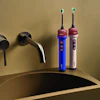
In my house, we place the powered flosser beside the powered toothbrush. The toothbrush becomes the cue and anchor for the next behavior. There’s no complicated tracking system or ceremonial unspooling of string floss. The tools simply live together.
I tell patients to keep Slate’s Mini Flossers where life happens: in a purse, at a desk, in a travel bag or -- let’s be real -- beside the couch where they binge Netflix.
I’ve learned that consistency matters more than creating a perfect bathroom ritual. If a patient progresses from no interdental cleaning to several effective sessions each week, I recognize that as progress and build from it.
As clinical oral health professionals, our job isn’t to catch patients lying about flossing. It’s to identify inflammation, understand the emotion beneath the answer, remove practical barriers, and help patients find an appropriate tool they’ll actually use.
Curiosity beats confrontation. Practicality beats perfection. And sometimes, better oral health begins with a bunch of giggly girls at a sleepover and a box of colorful dental goodies in an upstairs foyer.
Melissa K. Turner is a dental industry strategist; conference and brand architect; and founder of the HALO System, a framework focused on influence, visibility, and leadership in the age of AI. Learn more about her at www.MelissaKTurner.com.
The comments and observations expressed herein do not necessarily reflect the opinions of DrBicuspid.com, nor should they be construed as an endorsement or admonishment of any particular idea, vendor, or organization.