During the Miss Grand Thailand 2026 preliminary round on March 25, 18-year-old contestant Kamolwan Chanago was midintroduction when her upper veneers loosened and started to fall out of her mouth on a live stream watched by millions. She handled it beautifully -- she turned away, popped them back in, and walked the runway like nothing had happened. The crowd cheered. The internet did what the internet does.
Within 48 hours, the clip was on TMZ, Fox News, People, and every dental forum. Your next consult or three may likely bring it up. They'll sit in your chair, pull up the video, and ask, “Can that happen to me?”
Here is what I tell my patients, and what I encourage every dentist reading this to understand at the structural level.
The real problem behind what you saw
 Dr. Pia Lieb.
What happened on that stage was not random bad luck. It was physics.
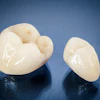
The dominant trend right now -- especially overseas, but increasingly in the U.S. -- is toward 3D-printed or CAD/CAM-milled veneers. A computer carves a block of porcelain into the restoration. The process requires thickness because the milling bur has physical limitations on how thin it can cut. The veneer is bulky by design.
To make room for that bulk, dentists grind the natural tooth down, sometimes aggressively. We are talking about reducing a tooth to a third of its original length, width, and thickness, then covering it with a porcelain shell that makes up the other two-thirds. That ratio is the problem.
Teeth move, porcelain doesn’t
Natural teeth flex. Every time you speak, chew, clench, or even swallow, your teeth bend microscopically. Think of trees in the wind. You do not see them moving, but they are constantly bending and absorbing force. Your teeth do the same thing all day long.
A thin, handcrafted porcelain veneer can flex with that movement. It rides the tooth. It stays bonded. A thick, rigid, computer-milled block of porcelain cannot. It sits on a shaved-down stump and fights every micromovement. Over time -- sometimes not much time at all -- the bond fails. The veneer pops off. It is not a mystery. It is material science.
The preparation problem nobody talks about
Many of the dentists placing these restorations are not cosmetically trained. They do not understand minimal or no-prep veneer work. They know one approach: Grind it down, send it to the mill, cement it on.
Proper veneer preparation is conservative. You preserve as much natural enamel as possible, because enamel is what porcelain bonds to best. When you shave a tooth to a nub, you are into dentin, a completely different bonding surface with significantly lower adhesion strength. Now you have a thick restoration on a weak foundation. That is a recipe for exactly what the world just watched happen.
The cementation factor
Even with a properly prepared tooth and a well-made veneer, the wrong cementation protocol will undermine everything.
Bonding a porcelain veneer is not just gluing it on. It is a precise, technique-sensitive, multistep process. The internal surface of the veneer needs to be etched with hydrofluoric acid and treated with a silane coupling agent to create a micromechanical and chemical bond with the cement.
The tooth surface needs to be etched, primed, and kept completely isolated from moisture. Any saliva contamination during bonding compromises the seal. The resin cement itself has to be selected for the right viscosity, shade, and curing properties, then light-cured at the correct intensity and duration.
Skip any of those steps and the bond is compromised from Day 1. The veneer might feel solid when the patient walks out. But every time that tooth flexes under normal function, a weak cement joint is absorbing force it was not built to handle. Over weeks or months, microgaps form, the seal breaks down, and the veneer lets go.
This is where training separates cosmetic specialists from general practitioners who dabble in veneers. The preparation, the fabrication, and the cementation are a chain. Every link has to hold, or the whole thing fails.
Handcrafted vs. machine-made: It actually matters
The other piece patients will not know to ask about is the difference between a veneer made by a skilled ceramist and one cut by a machine.
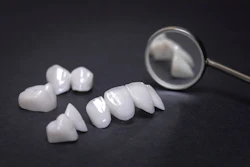
A master ceramist can build a veneer as thin as a contact lens -- layer by layer, shade by shade, the translucency matched to the surrounding teeth. That thinness is not a compromise, it is the whole point. Less porcelain means the restoration moves with the tooth, the bond stays stronger, and the result looks and feels natural.
A CAD/CAM mill physically cannot produce that level of thinness or detail. The bur has a minimum cutting diameter. The block is one uniform shade. The result is thicker, more opaque and often larger than the natural tooth it is replacing.
Here is the rule I teach: You cannot have more porcelain on a tooth than you have tooth structure underneath it. Violate that ratio, and you are setting up a failure. Maybe not today. Maybe not on live television. But eventually.
What to tell your patients
When someone brings this viral video up in your chair, they are not really asking about a beauty queen in Thailand. They are asking whether they can trust the work in their own mouth or the work they are considering.
If they have veneers and are worried: Properly bonded, thin porcelain veneers on conservatively prepared teeth with correct cementation are incredibly stable. If the work was done right, they have nothing to worry about.
If they are considering veneers and are nervous: Walk them through the difference between minimal-prep, handcrafted veneers and aggressive-prep milled restorations. Technique, training, and cementation protocol matter more than the brand name on the porcelain.
If they are shopping on price: This is where you earn your credibility. Cheaper often means thicker restorations, more aggressive preparation, corners cut on cementation, and -- as millions just watched -- a higher chance of something going wrong at the worst possible moment.
The bottom line
That viral clip is not a freak accident. It is a predictable outcome when you combine overprepared teeth, thick machine-milled porcelain, and compromised cementation. The tooth flexed. The porcelain did not. The bond gave way. Your patients will see that video. Some already have. Be the one who can explain exactly why it happened and why it will not happen to them. That is not marketing. That is what proper training looks like.
Dr. Pia Lieb is an assistant professor emerita at the New York University College of Dentistry and the founder of Cosmetic Dentistry Center NYC, a Manhattan practice specializing in minimally invasive, handcrafted porcelain veneers.
The comments and observations expressed herein do not necessarily reflect the opinions of DrBicuspid.com, nor should they be construed as an endorsement or admonishment of any particular idea, vendor, or organization. Some content may be AI-generated.